

Periods of market uncertainty often create a powerful temptation to make changes to your portfolio. Economic headlines, interest-rate expectations, and geopolitical developments are all evolving rapidly.
In these environments, investors frequently ask the same question: “Should I be doing something differently?”
While every market cycle presents unique challenges, we believe that the greatest threats to long-term wealth creation are often not external events, but the decisions investors make in response to them.
The most successful investors understand that uncertainty is an inherent part of investing. Rather than attempting to correctly predict and react to market movements, we believe it is important for investors to focus on managing risk and maintaining discipline.
Market Volatility and the Illusion of Control
Periods of volatility can create the impression that frequent portfolio adjustments improve outcomes. In reality, many of these decisions are driven by short-term narratives rather than long-term fundamentals.
While risk management is important, there is a difference between strategic portfolio adjustments and emotional reactions to market events. A disciplined investment process focuses on factors within an investor’s control:
- Asset allocation
- Portfolio diversification
- Tax efficiency
- Spending and withdrawal strategies
- Liquidity management
These decisions tend to have a far greater impact on long-term results than attempts to predict market movements.
Intra-Year Declines
The chart below illustrates an important reality of investing: market declines are a normal part of the investment experience. While the S&P 500 has experienced intra-year pullbacks in many years, those declines have not always prevented the market from finishing the year with positive returns.
The light blue dot indicates the maximum decline of the S&P 500 that occurred during the year while the dark blue bar signifies the annual return of that same year.
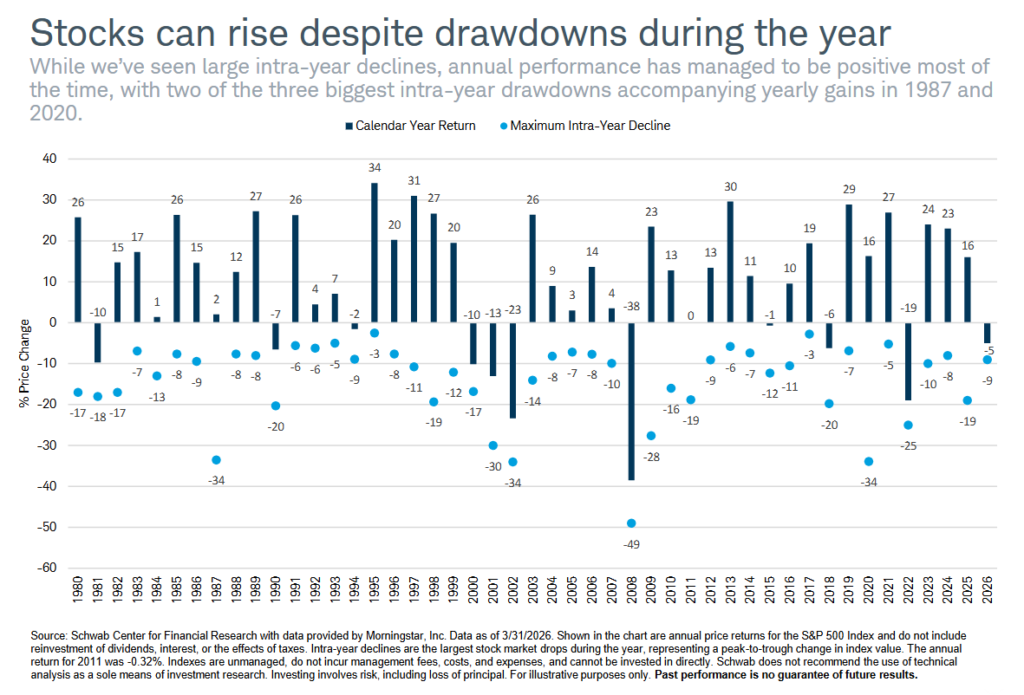
Chart source: Charles Schwab’s Quarterly Chartbook
This chart serves as a reminder that reacting to short-term market volatility can be costly. Investors who exit the market during periods of decline face the difficult challenge of determining when to re-enter, a decision that is often more difficult than deciding when to sell.
History shows that markets rarely provide an “all clear” signal. By the time economic conditions appear stable and investor confidence returns, markets have often already realized a significant portion of the recovery. Investors who attempt to time the market risk missing critical periods of recovery that can have a meaningful positive impact on long-term returns.
If there is one certainty in investing, it is that market volatility will persist, economic forecasts will evolve, and there will always be new risks that emerge.
The investors most likely to achieve their long-term objectives are those who remain committed to their investment strategy, even when uncertainty tempts them to make changes. We believe that discipline remains one of the most valuable assets an investor can own.
If you would like to review your investment strategy or financial plan, we welcome the opportunity to discuss how these current market conditions may affect your long-term objectives.
Ashlyn Tucker, CFA, CDFA, M. Fin
ashlyn@rmhinvestment.com
Richard Mundinger, CFA
richard@rmhinvestment.com
520-314-2300
This newsletter is for educational purposes only, this is not investment advice.