

We have been carefully monitoring the geopolitical events over the last week and reflecting on the implications for investor sentiment, portfolios, and the broader economy. Volatility can create short-term emotions and panic in both people and the markets. Rather than chasing headlines or attempting to time the market, the most successful investors stay focused on long-term fundamentals and opportunities.
The energy sector is one of the most impacted sectors during geopolitical conflicts. Let’s take a look at potential impacts on energy supply, the economy, and energy stocks.
Energy Supply
One of our Four Themes for 2026 was Energy Infrastructure and Supply. We forecasted that discussions surrounding energy independence and availability would be a key factor this year. The Strait of Hormuz, one of the world’s most important oil chokepoints, is effectively closed due to the conflict in the Middle East.
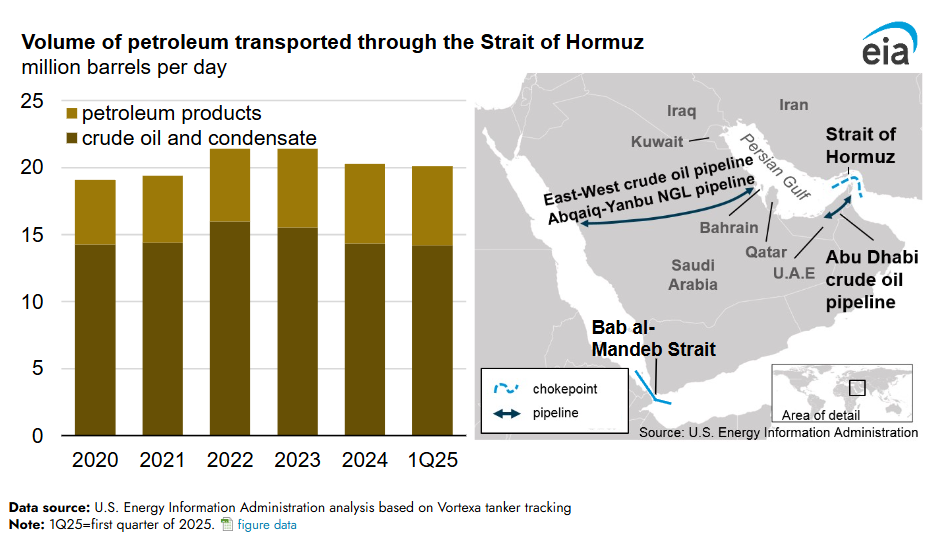
In 2025, oil flow through the strait was around 20 million barrels a day, which is estimated to be about 20% of global petroleum liquid consumption.
What is the impact on the U.S. supply specifically?
“In 2024, the United States imported about 0.5 million b/d of crude oil and condensate from Persian Gulf countries through the Strait of Hormuz, accounting for about 7% of total U.S. crude oil and condensate imports and 2% of U.S. petroleum liquids consumption. In 2024, U.S. crude oil imports from countries in the Persian Gulf were at the lowest level in nearly 40 years as domestic production and imports from Canada have increased.” (Source).
Even though the amount of oil the U.S. sources from the strait is relatively small, we still feel the impact because oil is globally priced using benchmarks. Benchmark pricing is used to standardize the trading of different crude oil grades. The three different benchmarks are as follows.
- West Texas Intermediate (WTI): The primary benchmark for crude oil in the United States, traded on futures markets and known for its high quality (light, sweet crude).
- Brent Crude: The most widely used global benchmark, pricing a large portion of internationally traded oil.
- Dubai Crude: Often used as a reference for oil exported from the Middle East to Asia.
Oil transactions are usually priced as taking the benchmark and then adding a premium or discount. Meaning that a supply disruption anywhere can lead to a price impact everywhere.
How do Oil Prices Impact the Economy?
Higher energy prices impact the economy by increasing the amount that households and businesses have to spend on necessities such as gasoline and utility bills. The magnitude of this impact depends on how long prices stay elevated for.
Inflation measures react quickly because energy prices are included directly in price data.
Energy prices feed directly into both the CPI (Consumer Price Index) and the PPI (Producer Price Index). Both of these measures are published by the Bureau of Labor Statistics on a monthly basis. Since gas prices change daily, a sharp move in oil prices will begin influencing inflation measures in the same month.
It can take a lag of anywhere from 6-12 months to fully identify the economic impact of an oil price spike. The magnitude of impact varies based on how long prices stay elevated for and if businesses absorb or pass through costs.
Energy in the Equity Markets
The energy sector can be an important portfolio diversifier during periods of inflation or geopolitical uncertainty. Many of the stocks in this sector also pay out regular dividends that help investors bolster their income during periods of price volatility.
There are two main ways we group the energy sector: upstream and midstream.
Upstream:
Upstream companies explore for and produce oil and natural gas. Their revenues can be heavily dependent on commodity prices. Examples include companies like ExxonMobil, Chevron, and ConocoPhillips.
Investment characteristics of upstream companies are as follows:
- Profits rise when oil and gas prices increase
- Can be more volatile and cyclical with the economy
- Dividends may fluctuate with energy prices
Midstream:
Midstream companies are also referred to as pipelines. They transport and store oil or natural gas. Examples include Kinder Morgan and Energy Transfer.
Investment characteristics of midstream companies:
- Revenue comes from charging fees to move oil or gas through pipelines
- Revenue is tied to volume transported, not commodity price
- Long-term transportation contracts result in them being less sensitive to short-term price swings
Both types of companies can play a role in a diversified portfolio. Energy stocks (in particular pipelines) are a core, long-term holding for many of our clients.
If you have questions on how current events impact your investment plan, reach out to us today.
At RMH, we believe strategic investing begins with a clear plan. A diversified portfolio that aligns with an investor’s goals, time horizon, and risk tolerance, is designed to navigate these constantly changing market environments.
This newsletter/article is for educational purposes only, this is not investment advice.